That Was The Week That Was — 19th April 2026
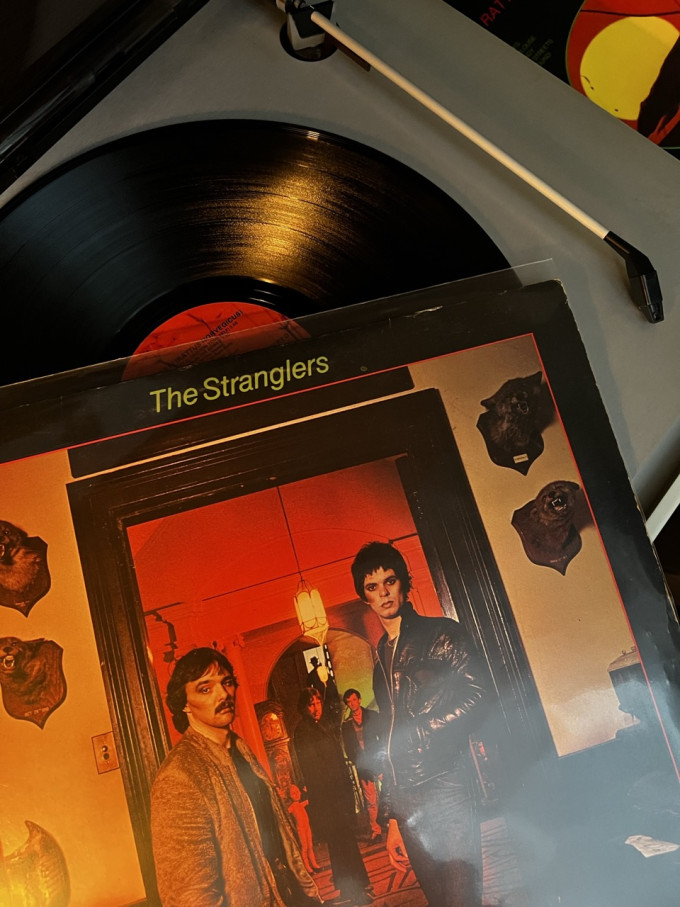
After picking up an original 1977 pressing of The Strangler's debut album Rattus Norvegicus from my local record shop, it got me thinking why I always try and seek out the original rather than a reissue. Whilst it's true that reissues can sometimes be a better pressing, I think it comes down to having the object that first appeared at that moment in time, and how — like the idea of a stub in Gibson's The Peripheral — culture then splintered onto a different path because of this punctuated moment. I'm not talking large cultural shifts, but subtle, small inflections which leave their mark going forward.
When purchasing these secondhand vinyls they very often need a good clean. Over the years I've used various approaches including Near Mint, but I've never found that any good. After talking with Paul at the local record shop he recommended a mixture of one part Isopropyl to three parts distilled water and then add a very tiny amount of washing-up detergent. Have to say it worked like a charm, cleaning-up a particularly dirty copy of Sister Sledge's We Are Family so now I could listen to it without dust building up on the stylus by track two!
So whilst the bassline of Peaches was signifying the start of side 2, I was working on the title sequence for the upcoming Beyond Tellerrand conference in Germany. After a bit of back and two with Tobi Lessnow, the music was complete and the titles were pretty much ready.
Brad Frost published an interview with me we recorded the week before which was a lot of fun. A few weeks before Brad posted his thoughts about the use of AI in respect of a creative practice and it was a welcome refreshing take about being open to the possibilities. So we talked about that amongst many other things.
At the end of the week their was the online launch of the group show Gazelli Art House: After the Dataset as part of the virtual program at HEK featuring myself and other artists who've exhibited with Gazelli in the past.
After the Dataset is a virtual exhibition examining how artificial intelligence systems mediate cultural memory, imagination, and visual knowledge. Bringing together artists working with machine learning, generative systems, simulation, and archival materials, the project explores how AI technologies reshape the production and circulation of images, narratives, and identities. The participating artists, Memo Akten & Katie Hofstadter, Nouf Aljowaysir, Morehshin Allahyari, Brendan Dawes, Jake Elwes, and Matteo Zamagni, approach artificial intelligence not simply as a tool but as a cultural infrastructure embedded within historical, political, and aesthetic frameworks. Their works examine how datasets carry inherited assumptions and cultural residues while revealing the speculative capacities of generative systems to produce new visual imaginaries. Across the exhibition, archival material, mythological narratives, ecological simulations, and performative interventions are reconfigured through algorithmic processes, exposing the entanglement between human knowledge systems and machine learning architectures. Presented within HEK’s virtual environment, the exhibition unfolds as a constellation of moving-image works reflecting on how artificial intelligence simultaneously mirrors the past and constructs possible futures.
You can view the exhibition online here.
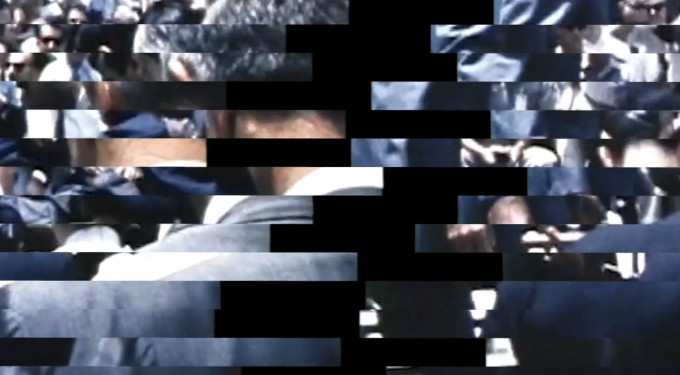
Meanwhile in Touch Designer I played with a cut-up technique using POP geometry and manipulating the Tex attribute to create cut-up like montages. The key to this technique was using the PrimI attribute, which you can see when you add a Math POP and use that as the lookup in any subsequent noise so it offsets primitives as a whole rather than individual points.